

GAR 3400 Thermal Coal
Low-rank sub-bituminous blending gradeFuel blending, CFB boilers, and power units with strict sulfur limits
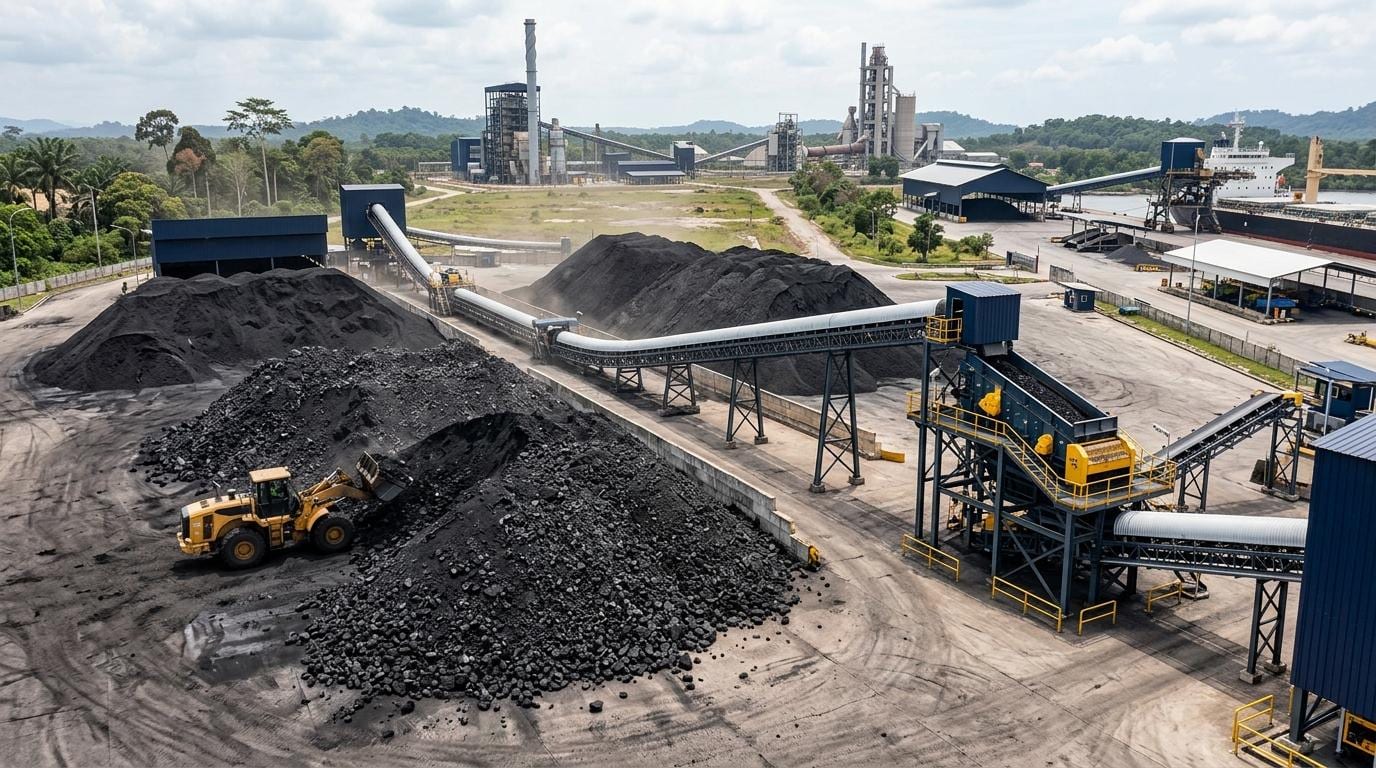
Source thermal coal directly from our network of 21 Kalimantan partner mines. We supply power utilities, industrial boilers, and cement plants across Asia under standard Incoterms® 2020 delivery terms.
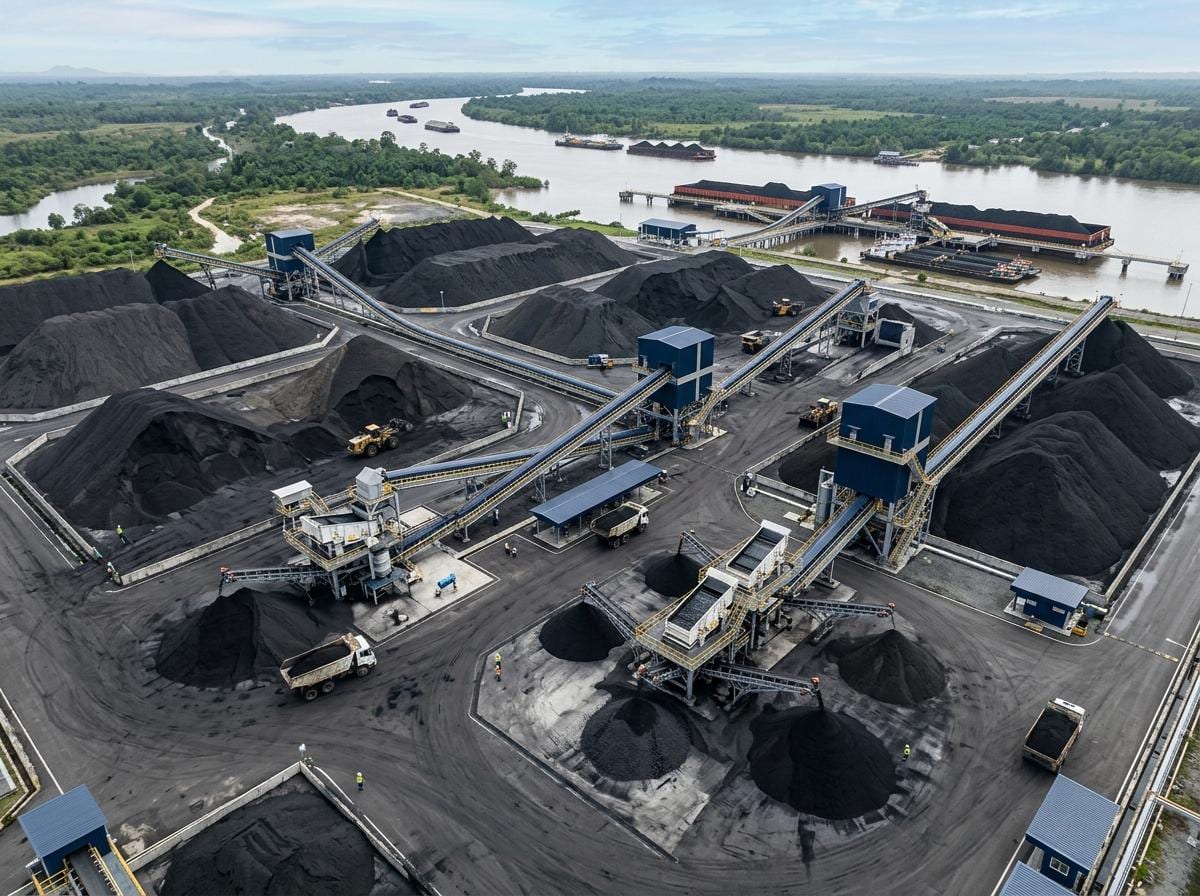
Direct Mine-to-Anchorage Matching: We pair mine-mouth coal quality directly with loading slots at Taboneo, Asam Asam, Muara Satui, and Tanjung Pemancingan, so the cargo loaded onto your vessel matches your contract spec.
Export coal contracts settle against ASTM and ISO laboratory results. Here is what each parameter measures and how it affects boiler performance and freight cost.
Calorific value measures the heat released when coal burns. Indonesian exports trade on GAR (Gross As Received), which includes total moisture. GCV (ADB) is tested on air-dried samples in the lab, while NAR (Net As Received) deducts the heat lost to evaporating water, showing the usable heat your boiler actually recovers.
GAR reflects the coal as shipped with all its moisture intact, making it the standard basis for invoicing and ICI pricing. GCV (ADB) is measured in a bomb calorimeter after air-drying at roughly 25°C and 60% humidity. NAR represents the net thermal energy available inside the furnace after moisture vaporization.
Lower-calorific coal requires higher tonnage through the pulverizers and air ducts to reach the same steam output. Supercritical and ultra-supercritical units calibrate feed rates against NAR to keep steam temperatures steady and heat distribution even.
Total Moisture (ARB) combines surface water with moisture trapped inside the coal's pores, directly affecting ocean freight cost and material handling. Inherent Moisture (ADB) is the pore moisture that remains after the coal is air-dried.
Every extra percentage point of moisture adds non-combustible weight to your freight bill. Excess surface water can also cause sticking in transfer chutes and unloading hoppers, which makes stockpile drainage and barge hold care essential.
Indonesian sub-bituminous coals naturally hold higher inherent moisture (12% to 18% ADB) and ignite quickly. Higher-rank bituminous grades (GAR 5600+) hold far less (6% to 10% ADB) and pack more energy per metric ton.
Ash is the non-combustible mineral residue left after burning, which governs slagging and disposal volume. Volatile Matter is the combustible gas released upon heating, controlling how fast the coal ignites and how stable the flame stays.
Indonesian steam coal typically carries low ash (4% to 8% ADB), reducing pulverizer wear and lightening the load on electrostatic precipitators (ESP). Ash Fusion Temperatures (AFT) indicate how likely that ash is to form slag inside the furnace.
High volatile matter (35% to 44% ADB) promotes quick ignition and a steady flame, even when a boiler runs at reduced load. That makes Indonesian coal practical for blending with slower-burning domestic fuels.
Indonesian steam coal is widely used for its low sulfur content (typically 0.2% to 1.0%). Lower sulfur cuts flue-gas desulfurization (FGD) operating costs and helps power plants stay within SO2 emission caps.
South Kalimantan seams frequently test below 0.5% sulfur, making them effective for blending down higher-sulfur fuels such as US coal or petcoke to meet national emission limits.
Lower sulfur trioxide (SO3) levels in flue gas reduce the acid dew point across air preheaters and economizer tubes. That limits cold-end corrosion and extends tube service life.
HGI measures how easily coal grinds into pulverized fuel for boiler burners. A higher HGI (50 to 60) indicates softer coal that draws less mill power; a lower HGI (40 to 45) indicates harder bituminous coal.
HGI directly determines pulverizer capacity (tons per hour) and specific power consumption (kWh per ton). Indonesian sub-bituminous coals generally fall in the 48 to 56 HGI range, keeping mill motors efficient.
Very soft coals (HGI above 60) can generate excess fines along conveyor systems. Proper stockpile compaction and water-mist suppression keep dust under control during handling.
Fixed Carbon is the solid combustible char that remains after volatile gases burn off. Standard export sizing is 0 to 50 mm (at least 90% passing), ready for conveyor belts and automated boiler feeders.
Fixed Carbon (typically 36% to 46%, calculated by difference) burns out as solid char during furnace residence time. Comparing Fixed Carbon to Volatile Matter (the Fuel Ratio) gives a clear signal of ignition speed.
Port stockyards in Kalimantan run two-stage crushing to hold the 0 to 50 mm export standard (minimum 90% passing), preventing oversized lumps from jamming ship loaders or plant feeders.
Compare full ASTM and ISO lab parameters across our 9 export grades (GAR 3400 to GAR 6300). Every cargo is sampled and certified by independent surveyors prior to loading.
Fuel blending, CFB boilers, and power units with strict sulfur limits
| Grade Index | GAR (ARB) kcal/kg | NAR (ARB) kcal/kg | GCV (ADB) kcal/kg | TM (ARB) Typ. / Max Rej. | IM (ADB) % Typ. | Ash (ADB) % Typ. | VM (ADB) % Typ. | FC (ADB) % By Diff | TS (ADB) % Max | HGI Points | Size 0-50 mm |
|---|---|---|---|---|---|---|---|---|---|---|---|
| GAR 3400 Low Grade | 3,400 kcal/kg | 3,050 kcal/kg | 4,850 kcal/kg | 38.0% Max: 41.0% | 15.0% | 5.0% | 40.0% | 40.0% | 0.30% | 55 | 0 - 50 mm (Min. 90%) |
| GAR 3800 Low Grade | 3,800 kcal/kg | 3,450 kcal/kg | 5,050 kcal/kg | 36.0% Max: 39.0% | 14.0% | 5.5% | 40.0% | 40.5% | 0.35% | 54 | 0 - 50 mm (Min. 90%) |
| GAR 4100 Low Grade | 4,100 kcal/kg | 3,750 kcal/kg | 5,200 kcal/kg | 34.0% Max: 37.0% | 13.5% | 6.0% | 40.0% | 40.5% | 0.45% | 53 | 0 - 50 mm (Min. 90%) |
| GAR 4200 Mid Grade | 4,200 kcal/kg | 3,850 kcal/kg | 5,250 kcal/kg | 33.0% Max: 36.0% | 13.0% | 6.0% | 40.0% | 41.0% | 0.50% | 52 | 0 - 50 mm (Min. 90%) |
| GAR 4500 Mid Grade | 4,500 kcal/kg | 4,150 kcal/kg | 5,450 kcal/kg | 29.0% Max: 32.0% | 12.0% | 6.5% | 39.5% | 42.0% | 0.60% | 51 | 0 - 50 mm (Min. 90%) |
| GAR 5000 Mid Grade | 5,000 kcal/kg | 4,680 kcal/kg | 5,800 kcal/kg | 23.0% Max: 26.0% | 10.5% | 7.0% | 39.5% | 43.0% | 0.70% | 49 | 0 - 50 mm (Min. 90%) |
| GAR 5300 High CV | 5,300 kcal/kg | 4,980 kcal/kg | 6,050 kcal/kg | 21.0% Max: 24.0% | 9.5% | 7.5% | 39.0% | 44.0% | 0.75% | 48 | 0 - 50 mm (Min. 90%) |
| GAR 5800 High CV | 5,800 kcal/kg | 5,500 kcal/kg | 6,450 kcal/kg | 14.5% Max: 17.0% | 7.5% | 8.0% | 39.5% | 45.0% | 0.80% | 47 | 0 - 50 mm (Min. 90%) |
| GAR 6300 High CV | 6,300 kcal/kg | 6,020 kcal/kg | 6,850 kcal/kg | 12.5% Max: 14.5% | 6.0% | 8.5% | 40.0% | 45.5% | 0.85% | 46 | 0 - 50 mm (Min. 90%) |
3,400 kcal/kg
Fuel blending, CFB boilers, and power units with strict sulfur limits
3,800 kcal/kg
Pulverized coal boilers, CFB units, and low-sulfur utility blending
4,100 kcal/kg
Benchmark sub-bituminous fuel for power generation and cement kilns
4,200 kcal/kg
Utility power plants, cement kilns, and industrial steam boilers
4,500 kcal/kg
Captive industrial power plants, paper mills, and textile facilities
5,000 kcal/kg
High-efficiency utility boilers and heavy industrial steam generation
5,300 kcal/kg
High-efficiency power stations, cement kilns, and export blending
5,800 kcal/kg
Supercritical power plants, metal smelters, and high-heat industrial kilns
6,300 kcal/kg
High-temperature industrial kilns, metallurgical blending, and export benchmarks
Utility power plants, captive industrial boilers, and cement kilns
PT Banjar Bumi Persada (1,132 Ha), CV Cinta Puri Pratama (1,323 Ha), CV Suraindo Bara (1,785 Ha), CV Mitra Mining (1,670 Ha)
Low-ash, low-sulfur sub-bituminous coal with high volatile matter for fast ignition. Well suited for CFB boilers and fuel blending when strict sulfur emission caps apply.
| Parameter | Typical Value | Test Standard |
|---|---|---|
| Gross Energy (GAR / ARB) | 3,400 - 4,200 kcal/kg | ASTM D5865 |
| Net Energy (NAR / ARB) | 3,050 - 3,850 kcal/kg | ASTM D5865 |
| Gross Energy (GCV / ADB) | 4,850 - 5,250 kcal/kg | ASTM D5865 |
| Total Moisture (TM / ARB) | 33.0% - 38.0% | ASTM D3302 |
| TM Rejection (ARB Max) | 36.0% - 41.0% | ASTM D3302 |
| Inherent Moisture (IM / ADB) | 13.0% - 15.0% | ASTM D3173 |
| Ash Content (ADB) | 5.0% - 6.0% | ASTM D3174 |
| Volatile Matter (VM / ADB) | 40.0% | ASTM D3175 |
| Fixed Carbon (FC / ADB) | 40.0% - 41.0% (by diff.) | ASTM D3172 |
| Total Sulfur (TS / ADB Max) | 0.30% - 0.50% | ASTM D4239 |
| Hardgrove Index (HGI) | 52 - 55 | ASTM D409 |
| Size Specification (0-50 mm) | 0 - 50 mm (Min. 90%) | ASTM D4749 |
Utility power boilers, pulp and paper mills, chemical plants, and smelters
PT Energi Bumi Tapin (199 Ha), CV Tiga Serangkai Binuang (576 Ha), PT Indomarta Multi Mining (1,037 Ha), CV Lestari (150 Ha)
Moderate-moisture steam coal that delivers steady heat output across power generation, paper manufacturing, and continuous industrial boiler operations.
| Parameter | Typical Value | Test Standard |
|---|---|---|
| Gross Energy (GAR / ARB) | 4,200 - 5,000 kcal/kg | ASTM D5865 |
| Net Energy (NAR / ARB) | 3,850 - 4,680 kcal/kg | ASTM D5865 |
| Gross Energy (GCV / ADB) | 5,250 - 5,800 kcal/kg | ASTM D5865 |
| Total Moisture (TM / ARB) | 23.0% - 33.0% | ASTM D3302 |
| TM Rejection (ARB Max) | 26.0% - 36.0% | ASTM D3302 |
| Inherent Moisture (IM / ADB) | 10.5% - 13.0% | ASTM D3173 |
| Ash Content (ADB) | 6.0% - 7.0% | ASTM D3174 |
| Volatile Matter (VM / ADB) | 39.5% - 40.0% | ASTM D3175 |
| Fixed Carbon (FC / ADB) | 41.0% - 43.0% (by diff.) | ASTM D3172 |
| Total Sulfur (TS / ADB Max) | 0.50% - 0.70% | ASTM D4239 |
| Hardgrove Index (HGI) | 49 - 52 | ASTM D409 |
| Size Specification (0-50 mm) | 0 - 50 mm (Min. 90%) | ASTM D4749 |
Ultra-supercritical power plants, metal smelters, and export blending
PT Tanjung Alam Jaya (6,032 Ha PKP2B), PT Kadya Caraka Mulia (4,628 Ha PKP2B), PD Baramarta (2,600 Ha PKP2B), PT Energi Bumi Jaya Mandiri (151 Ha)
Low-moisture bituminous coal sourced from PKP2B partner mines. Built for ultra-supercritical boilers, high-temperature kilns, and export-grade blending.
| Parameter | Typical Value | Test Standard |
|---|---|---|
| Gross Energy (GAR / ARB) | 5,600 - 6,300 kcal/kg | ASTM D5865 |
| Net Energy (NAR / ARB) | 5,290 - 6,020 kcal/kg | ASTM D5865 |
| Gross Energy (GCV / ADB) | 6,290 - 6,850 kcal/kg | ASTM D5865 |
| Total Moisture (TM / ARB) | 12.5% - 17.1% | ASTM D3302 |
| TM Rejection (ARB Max) | 14.5% - 19.5% | ASTM D3302 |
| Inherent Moisture (IM / ADB) | 6.0% - 8.3% | ASTM D3173 |
| Ash Content (ADB) | 7.8% - 8.5% | ASTM D3174 |
| Volatile Matter (VM / ADB) | 39.3% - 40.0% | ASTM D3175 |
| Fixed Carbon (FC / ADB) | 44.6% - 45.5% (by diff.) | ASTM D3172 |
| Total Sulfur (TS / ADB Max) | 0.78% - 0.85% | ASTM D4239 |
| Hardgrove Index (HGI) | 46 - 47 | ASTM D409 |
| Size Specification (0-50 mm) | 0 - 50 mm (Min. 90%) | ASTM D4749 |
Off-take, joint operation (KSO), and marketing agreements with 21 licensed IUP and PKP2B concessions spanning 22,874 hectares across South Kalimantan.
| Mining Partner | Area (ha) | Permit | Calorific Value GAR (ARB) | Region |
|---|---|---|---|---|
| | 6,032 Ha | PKP2B | 5800 - 6300 kcal/kg | South Kalimantan |
| | 4,628 Ha | PKP2B | 5600 - 6000 kcal/kg | South Kalimantan |
| | 2,600 Ha | PKP2B | 6000+ kcal/kg | South Kalimantan (Banjar) |
| | 151 Ha | IUP | 6000 up kcal/kg | South Kalimantan |
| | 80 Ha | IUP | 5600 - 6000 kcal/kg | South Kalimantan (Kotabaru) |
| | 196 Ha | IUP | 5600 - 6000 kcal/kg | South Kalimantan |
| | 199 Ha | IUP | 4600 - 5000 kcal/kg | South Kalimantan (Tapin) |
| | 576 Ha | IUP | 4600 - 5000 kcal/kg | South Kalimantan (Binuang) |
| | 150 Ha | IUP | 4400 - 4600 kcal/kg | South Kalimantan |
| | 150 Ha | IUP | 4200 - 4600 kcal/kg | South Kalimantan |
| | 1,037 Ha | IUP | 4200 - 4400 kcal/kg | South Kalimantan |
| | 172 Ha | IUP | 3600 - 4600 kcal/kg | South Kalimantan |
| | 1,670 Ha | IUP | 3600 - 4800 kcal/kg | South Kalimantan |
| | 1,785 Ha | IUP | 3600 - 4200 kcal/kg | South Kalimantan |
| | 1,323 Ha | IUP | 3800 - 4000 kcal/kg | South Kalimantan |
| | 100 Ha | IUP | 3800 - 4200 kcal/kg | South Kalimantan |
| | 50 Ha | IUP | 3600 - 4000 kcal/kg | South Kalimantan |
| | 1,132 Ha | IUP | 3400 - 3800 kcal/kg | South Kalimantan |
| | 450 Ha | IUP | 3400 - 3800 kcal/kg | South Kalimantan |
| | 199 Ha | IUP | 3400 - 3600 kcal/kg | South Kalimantan |
| | 194 Ha | IUP | 3400 - 3600 kcal/kg | South Kalimantan |
Match your supply contract to your plant's burn rate, from single spot cargoes to multi-year off-take partnerships.
Utilities and industrial buyers covering urgent stock gaps or seasonal demand peaks.
IPPs and cement plants that need steady quarterly tonnage and predictable arrival windows.
National utilities and international trading desks securing dedicated multi-year Kalimantan supply.
Accredited third-party surveyors sample and test every cargo before and during vessel loading, so final invoicing rests on verified numbers.
SGS Indonesia, PT Sucofindo (Persero), PT Carsurin, and PT Surveyor Indonesia conduct mechanical sampling throughout barge conveyor loading.
Sampling: ISO 13909 / ASTM D2234. Calorific Value: ASTM D5865 / ISO 1928. Moisture: ASTM D3302. Sulfur: ASTM D4239. Ash: ASTM D3174.
Inspectors pull timed increments from the moving coal stream across the entire barge loading cycle, ensuring the composite sample reflects the full parcel.
The load-port Certificate of Analysis (COA) and draft-survey Certificate of Weight (COW) govern final invoice pricing and Letter of Credit (L/C) negotiation.
Channel samples taken directly from exposed coal seams before overburden removal and haulage.
Composite stockpile samples tested prior to conveyor loading to confirm the cargo sits within the target calorific band.
Independent surveyors pull scheduled increments across the full barge loading run.
Initial and final vessel draft surveys at Taboneo or Satui establish final tonnage (COW) alongside the COA.
Standard international trade terms for trial cargoes, spot shipments, and multi-year contracts out of South Kalimantan loading anchorages.
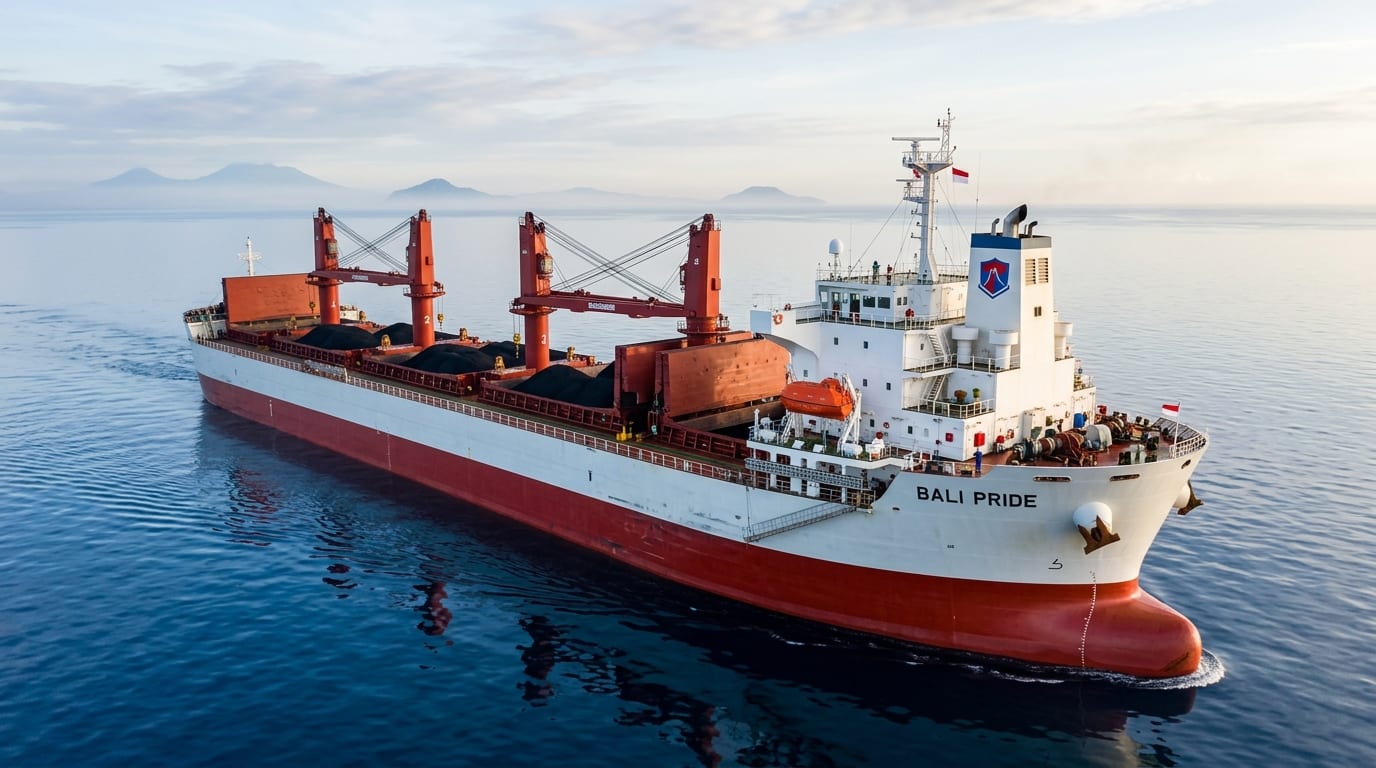
We load and trim coal into your nominated ocean vessel at Taboneo, Asam Asam, Muara Satui, or Tanjung Pemancingan. Risk transfers once the cargo passes the ship's rail.
Delivered directly to coastal discharge ports across East Asia, Southeast Asia, and South Asia. PT INI arranges ocean freight and, under CIF, marine cargo insurance.
Loaded onto 300 ft or 330 ft barges (7,500 to 10,000 DWT) across 12 partner jetties in South Kalimantan. Built for regional traders and domestic buyers managing their own onward logistics.
Share your boiler limits for calorific value, moisture, ash, and sulfur. We will match your requirements to available tonnage across our 21 partner mines, backed by SGS or Sucofindo pre-shipment testing and Incoterms® 2020 delivery.