

Quality Checks and Legal Compliance
How we check coal quality and export compliance for overseas buyers: automatic sampling at four stages, testing by certified independent labs, matching cargo to contract specs, and the official documents needed for export.
Four-Stage Sampling and Testing
Quality is checked at four stages, from the coal layer in the mine to the cargo holds of the ship at the loading point, so problems are found before the ship sails.
Samples From the Mine Face and Coal Layer
Strip samples are taken across working coal layers to see how quality, sulfur and moisture vary before mining starts.
Stockpile Samples Before Shipping
Samples are drilled from set stockpile lots to check consistency, volatile matter and size before coal is loaded onto river barges.
Automatic Sampling From the Falling Coal Stream
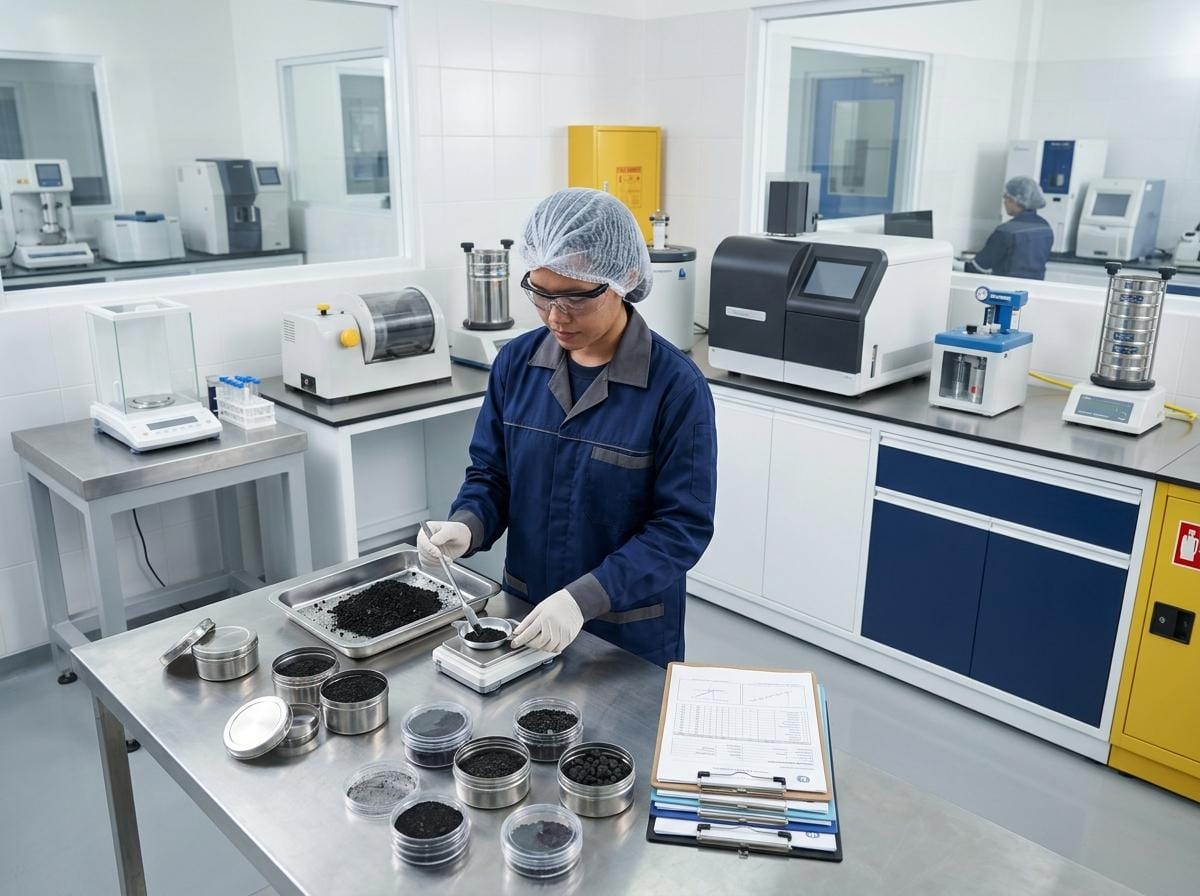
Automatic cutters take small portions across the whole falling coal stream while barges are loaded. The main sample is crushed and divided on the spot.
Offshore Loading and Draft Survey Check
An independent inspector watches coal move from barges to the ship, checks that the holds are dry, and carries out draft surveys (measuring how deep the ship sits) at the start and end to certify the bill of lading weight (COW).
Splitting Samples Four Ways and Protecting the Reference Sample
During conveyor loading, the mixed sample from the falling coal stream is divided by calibrated splitters into four identical, airtight sealed containers:
Inspector's Lab Sample
Tested for basic makeup, chemical makeup and energy content to produce the binding quality certificate (COA).
Buyer's Sample
A sealed airtight container given to the ship's captain or sent by courier to the buyer's lab for checking.
Seller's Stored Sample
Kept in our temperature-controlled sample store for internal checks and for tracing coal back to its mine layer.
Reference Sample for Disputes
Sealed with numbered tamper-evident seals and kept for 60 to 90 days. If there is a dispute over the coal specs, an agreed neutral lab tests it.
Independent Inspector Checks
Independent testing checks the cargo against the contract specs and produces certificates accepted in international trade.
Independent checks leave less room for contract disputes. We only work with certified inspection companies, who supervise sampling and testing from the river stockpiles to loading at the offshore anchorage.
Inspectors sample continuously during conveyor loading, using machines that take small portions from the falling coal stream, or take regular samples from barges, following ISO 13909 and ASTM D2234.
The quality certificate (COA) from the appointed independent inspector is the final proof that the coal meets the contract specs, and is used for the Letter of Credit.
SGS Indonesia
Global independent inspection company
Sampling before shipping, lab testing of mixed samples, draft survey and cargo hold inspection.
PT Sucofindo (Persero)
Government-certified inspector
Indonesian government-approved inspector for mineral checks and export certification.
PT Surveyor Indonesia
Government-certified inspector
Cargo sampling, weight checks by draft survey, and export trade compliance.
Carsurin
Independent testing lab
Certified steam coal lab testing to international ASTM and ISO standards.
What the Lab Tests and Which Standards It Uses
What we test on every export shipment, using ISO and ASTM methods.
| What Is Tested | Standard Used | Why It Matters |
|---|---|---|
| Gross Calorific Value (GCV / GAR) | ASTM D5865 / ISO 1928 | Sets the energy content and the price of the cargo. |
| Net Calorific Value (NCV / NAR) | Calculated using ISO 1928 | Usable heat for the boiler after subtracting the heat lost to evaporating moisture. |
| Total Moisture (TM) | ASTM D3302 / ISO 589 | Affects how efficiently coal burns, adjustments to the invoiced weight, and how the coal handles in the boiler. |
| Inherent Moisture (IM) | ASTM D3173 / ISO 11722 | Moisture held inside the coal's tiny pores. |
| Ash Content | ASTM D3174 / ISO 1171 | Affects ash buildup in the boiler, the amount of fine ash in the exhaust, and how well the dust-removal system works. |
| Volatile Matter (VM) | ASTM D3175 / ISO 562 | Affects how easily coal ignites, how steady the flame is, and how fully the coal burns. |
| Total Sulfur (TS) | ASTM D4239 / ISO 19579 | Decides how much work the sulfur-cleaning system for exhaust gas (FGD) must do and whether emission limits are met. |
| Hardgrove Grindability Index (HGI) | ASTM D409 / ISO 5074 | Shows how hard the coal is to grind, how much the grinding mill wears, and how much power it uses. |
| Ash Fusion Temperatures (AFT) | ASTM D1857 / ISO 540 | Four temperature readings (IDT, ST, HT, FT) used to judge the risk of ash sticking to boiler walls. |
Sets the energy content and the price of the cargo.
Usable heat for the boiler after subtracting the heat lost to evaporating moisture.
Affects how efficiently coal burns, adjustments to the invoiced weight, and how the coal handles in the boiler.
Moisture held inside the coal's tiny pores.
Affects ash buildup in the boiler, the amount of fine ash in the exhaust, and how well the dust-removal system works.
Affects how easily coal ignites, how steady the flame is, and how fully the coal burns.
Decides how much work the sulfur-cleaning system for exhaust gas (FGD) must do and whether emission limits are met.
Shows how hard the coal is to grind, how much the grinding mill wears, and how much power it uses.
Four temperature readings (IDT, ST, HT, FT) used to judge the risk of ash sticking to boiler walls.
Matching Coal Specs and Quality Limits
How cargo is matched to your boiler's needs, and how quality differences are settled in the contract through proportional price changes, penalty deductions and rejection limits.
| Coal Quality | Contract Target | Allowed Range | How Price Is Adjusted | When We Can Reject |
|---|---|---|---|---|
| Gross Calorific Value (GAR) | Contracted GAR kcal/kg (e.g., 4200 GAR) | Usually ±50 to ±100 kcal/kg (no penalty) | Price adjusted in proportion: (Actual GAR ÷ Guaranteed GAR) × FOB contract price | Usually the buyer may reject if energy content is 150–200 kcal/kg below the guarantee (set in the SPA) |
| Total Moisture (ARB) | Guaranteed TM % (e.g., 34.0% – 36.0%) | Up to the contract limit (no penalty) | Invoice weight is reduced by: Weight × (Actual TM − Contract TM) ÷ (100 − Actual TM) | Usually the buyer may reject if moisture is 2.0–3.0% above the contract limit (set in the SPA) |
| Total Sulfur (ADB) | Contracted TS % (e.g., 0.80% Max) | Up to contract maximum | A penalty for each 0.1% over the limit, with the rate agreed in the SPA | Hard rejection limit (for example, above 1.00% ADB, or as agreed in the contract) |
| Ash Content (ADB) | Contracted Ash % (e.g., 6.0% – 8.0% Max) | Up to contract maximum | A penalty for each 1.0% over the limit, with the rate agreed in the SPA | Hard rejection limit (for example, above 10.0% ADB, or as agreed in the contract) |
| Coal Size and Fine Particles (0–50 mm) | 0–50 mm (at least 90%) | 85–90% accepted with no penalty | A penalty applies if fine particles (under 2 mm) exceed the contract allowance | Depends on the boiler handling limits agreed in the contract schedule |
Price adjusted in proportion: (Actual GAR ÷ Guaranteed GAR) × FOB contract price
Invoice weight is reduced by: Weight × (Actual TM − Contract TM) ÷ (100 − Actual TM)
A penalty for each 0.1% over the limit, with the rate agreed in the SPA
A penalty for each 1.0% over the limit, with the rate agreed in the SPA
A penalty applies if fine particles (under 2 mm) exceed the contract allowance
How Contract Terms and COA Settlement Work
Penalty rates, bonus rates and rejection limits are set in the Sales and Purchase Agreement (SPA) agreed between both sides. Quality limits are binding based on the quality certificate (COA) that the independent inspector issues at the loading anchorage.
Shipping and Trade Documents
Every export shipment comes with a standard set of checkable documents for customs clearance at the destination and for the Letter of Credit.
Certificate of Sampling and Analysis (Quality Certificate)
Issued by: Certified inspector (SGS / Sucofindo / Carsurin)Confirms basic analysis, energy content (GAR/NAR), moisture, ash, volatile matter, sulfur and grindability (HGI). Binding for the final invoice price.
Certificate of Weight (from Draft Survey)
Issued by: Certified independent inspectorWeight in metric tons, confirmed by measuring how deep the ship sits before and after loading at the offshore anchorage.
Certificate of Origin
Issued by: Indonesian Ministry of Trade / Chamber of CommerceGovernment certificate confirming the coal is from Indonesia, so the buyer can claim lower import tariffs at Asian ports.
Clean On-Board Bill of Lading
Issued by: Ship's captain / shipping line agentA transferable ownership document confirming the cargo was loaded into the ship's holds in good condition. Required for the Letter of Credit.
Signed Invoice
PT Intan Nusantara IndonesiaItemized invoice showing the certified weight (COW) and any energy-content price adjustments based on the COA.
Packing List / Cargo Loading List
Issued by: PT Intan Nusantara Indonesia / Ship's agentThe amount of coal loaded in each ship hold, with loading density and layout.
Export Customs Declaration and Approval
Issued by: Indonesian Directorate General of Customs (DJBC)The export declaration (PEB) and the export release permit (NPE), confirming customs clearance for the ship to leave.
Laporan Surveyor (Surveyor Report)
Issued by: Government-approved inspector (Sucofindo / Surveyor Indonesia)A required export report confirming mining royalties were paid (e-PNBP SIMPONI) and which mine the coal came from, before export loading.
Certificate of Cargo Hold Cleanliness
Issued by: Independent marine inspectorConfirms the ship's holds were dry, clean, free of salt and earlier cargo, and ready for coal.
Statement of Facts (SOF, the port event log)
Issued by: Port shipping agent and ship's captainA time-ordered record of the ship's ready notice, weather delays, loading times and departure.
Download Our Exporter Documents and Company Credentials
Check PT INI's Registered Coal Exporter License (ET Batubara No. 03.ET-04.24.0202) and download our company presentation:
Export Licenses and Registration
PT Intan Nusantara Indonesia is a registered company with the government licenses listed below, and keeps records that trace each shipment.
Business License and Business ID (NIB)
Dated 27 February 2024. Issued by BKPM and the Ministry of Energy and Mineral Resources (ESDM). Business code (KBLI) 46610 (coal wholesale). Valid for 5 years (until 2029).
Registered Coal Exporter
Dated 19 April 2024. Issued by the Directorate General of Foreign Trade, Ministry of Trade. Valid for 3 years (until 2027).
Paid-Up Capital (Domestic Investment, PMDN)
A 100% domestic investment company with IDR 15 billion authorized capital (100% paid-up). Shareholders: Ronnie Aban (75%), Andi Ersom Massiwo (15%), Rachman Hakim Harahap (10%).
Shipment Traceability
Records of barge loading lists, independent lab COA/COW, surveyor reports (LS), draft surveys and customs Bills of Lading.
Company Registration and License List
Company information you can check against official Indonesian records.
PT INTAN NUSANTARA INDONESIA
Status: Domestic Investment Company (100% PMDN)
Incorporated: 2016 (Makassar, South Sulawesi)
License No. 81202142710160001
NIB: 8120214271016
KBLI: 46610 (Coal Wholesale)
Validity: 27 Feb 2024 – 2029 (5 Years)
ET: 03.ET-04.24.0202
Inatrade: 23178/INATRADE/04/2024
Issued By: Directorate General of Foreign Trade, Ministry of Trade
Validity: 19 April 2024 – April 2027
IDR 15,000,000,000
Status: Fully paid (IDR 15 billion)
Checked By: Ministry of Law and Human Rights / BKPM
Owners: Three founding shareholders
Ownership Record (Ministry of Law and Human Rights)
- Ronnie Aban IDR 11.25 billion (75%)
- Andi Ersom Massiwo IDR 2.25 billion (15%)
- Rachman Hakim Harahap IDR 1.5 billion (10%)
Makassar Head Office
Gedung Graha Pena Lt. 5, Jl. Urip Sumoharjo No. 20, Makassar 90234
WhatsApp: +62 856-2400-8063
Buyer Legal Checks Guide
A step-by-step checking guide for power company purchasing teams, commodity traders and trade finance banks to check where coal comes from, whether government royalties are paid, and whether export currency rules are followed.
Mining Permit and Clean & Clear (CNC) Status
Authority: ESDM MODI and MOMS recordsCheck the mine's IUP-OP or PKP2B permit directly on the Ministry of Energy and Mineral Resources (ESDM) MODI system.
Royalty Payment (Non-Tax State Revenue, PNBP)
Authority: Ministry of Finance SIMPONI systemCheck that royalties were paid electronically through the government's SIMPONI billing system.
Registered Coal Exporter License
Authority: Ministry of Trade (Kemendag)Check that the exporter's Registered Coal Exporter license from the Ministry of Trade (Kemendag) is valid.
Foreign Currency Rules (PP No. 21/2026 DHE SDA)
Authority: Bank Indonesia and LNSW (National Single Window)Check compliance with Indonesian Government Regulation No. 21 of 2026, in effect from 1 June 2026.
Oversight by PT Danantara (DSI)
Authority: PT Danantara Sumberdaya IndonesiaCheck the company's standing under the oversight of PT Danantara Sumberdaya Indonesia (DSI) for strategic commodities.
Independent Inspector's Lab Certification
Authority: KAN (National Accreditation Committee)Check that the appointed inspector's lab holds ISO/IEC 17025 certification and KAN certification for coal testing.
Following PP No. 21 of 2026 on Export Foreign Currency Earnings (DHE SDA)
PP No. 21 of 2026 covers foreign currency earnings from exporting natural resources (Devisa Hasil Ekspor, DHE SDA) and took effect on 1 June 2026. PT Intan Nusantara Indonesia follows its rules on keeping, holding and reporting foreign currency in Indonesia.
Export earnings go through special accounts (Rekening Khusus DHE SDA) at licensed Indonesian banks.
Trade data is checked automatically through Bank Indonesia (BI) and the Indonesian National Single Window (LNSW / DJBC).
Following the account rules lowers the risk of customs delays and holds on buyers' shipments.
Overseen by PT Danantara Sumberdaya Indonesia (DSI)
PT Intan Nusantara Indonesia works under the oversight of PT Danantara Sumberdaya Indonesia (DSI), which oversees exports of strategic natural resource (SDA) commodities. DSI acts as a supervisor, a central data hub and a helper for commodity exports.
Checks where coal comes from, how it moves, and whether export rules are followed.
Matches cargo specs, barge loading lists and export declarations across national databases.
Builds buyer confidence and speeds up government approvals for commodity trades.
PT Intan Nusantara Indonesia trades, checks quality and ships under written contracts and Indonesian regulations. We report our operations openly, backed by independent lab results and certified draft surveys. We make no promises outside the contract.
Supply commitments, loading dates and technical limits become binding only after a formal Sales and Purchase Agreement (SPA) is signed and the payment guarantees (such as the Letter of Credit) are confirmed.
Review Inspector Certificates
and Export Documents
Go through ASTM / ISO test reports, automatic sampling procedures and Indonesian export approvals with our compliance team. Review inspection records, quality documents and export paperwork for your specific contract.
Our quality and compliance team replies within 24 working hours.
We share the relevant documents depending on how far the deal has progressed and after we check the buyer.